When 3D Printing Isn’t Enough: Knowing When to Switch to CNC or Sheet Metal
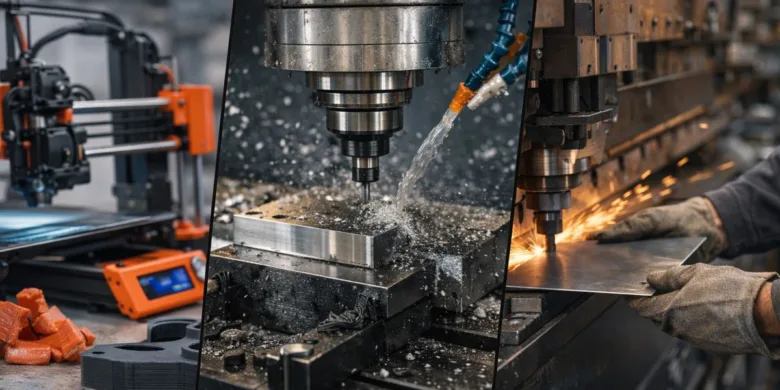
Knowing when 3D printing is not enough is what separates a quick prototype from a part you can trust.
3D printing is a manufacturing method that creates parts by depositing material layer by layer.
That structure makes it easy to produce complex shapes. Still, it also creates weak directions, surface variability, and fit problems that show up the moment a part meets heat, vibration, or tight assemblies.
CNC machining is a subtractive process that removes material from solid stock to achieve accurate geometry.
Sheet metal fabrication is a manufacturing approach that cuts and forms flat stock into stiff, lightweight structures.
If your build depends on predictable holes, flat faces, smooth motion, or clean panels, switching methods can be the fastest path to a better outcome.
This guide explains the initial limits, the triggers that indicate CNC or sheet metal, and a simple workflow you can repeat.
You will also learn what typically drives cost, how to redesign for each process, and how hybrid builds keep 3D printing in the loop without forcing it to do the wrong job.
What are the practical limits of 3D printing for functional parts?
The practical limits of 3D printing show up when the function depends on precision, repeatability, or uniform strength.
Layered polymers are materials that behave differently depending on direction because inter-layer bonding is weaker than in-layer strength.
That directional strength is not “bad,” but it becomes a constraint when loads reverse, parts heat up, or multiple components must align without hand-fitting.
Interfaces are the first place most makers feel the ceiling.
A bearing seat requires a stable diameter and roundness to avoid wobble and wear.
A mating face is a surface that needs flatness to avoid rocking, gaps, noise, or stress concentrations.
The issue is rarely one dramatic flaw.
It is usually small errors stacking together until assembly becomes a ritual of drilling, sanding, and reprinting.
If you want your tenth part to behave like your first, you may need a process that is built for repeatability, not for flexibility.
Below are 7 deal-breaker limits that often push makers toward CNC or sheet metal:
- Drift in critical dimensions from cooling and creep
- Snap risk along layer lines under vibration and shock
- Heat deformation near motors, electronics, or sunlight
- Rough surfaces that create friction in moving interfaces
- Long print times that turn one part into a high-risk job
- Support scars that ruin mating faces and cosmetic areas
- Inconsistent repeats when small variations break the fit
Which tolerance, strength, and surface finish problems show up first?
Tolerance problems first appear in holes, flats, and patterns because those features magnify small errors.
A printed hole is a feature that often prints undersized due to extrusion width and shrinkage.
A printed flat can warp because cooling is uneven across the part.
Strength problems show up when forces cross layer boundaries.
A cantilever bracket is a geometry that concentrates stress at the root and exposes weak inter-layer bonding if oriented poorly.
Surface finish becomes a functional issue when you rely on sliding, sealing, or smooth rotation.
When does part size or print time become the real bottleneck?
Print time becomes the bottleneck when iteration speed matters more than raw material cost.
A 20-hour print is a workflow risk because late failure wastes the most time.
Large parts are prone to warping and tolerance drift because temperature gradients are harder to control.
At a certain size, “good enough” stops being a tuning problem and becomes a physics problem.
A long panel is a shape that printed plastics struggle to keep straight and stable.
If your printer is tied up for days, outsourcing one metal job can be faster overall, even with shipping and lead time.
When is CNC machining the better move than printing?
CNC machining is the better choice when your part requires predictable dimensions, stable materials, and clean, functional surfaces.
CNC machining is a process that cuts away material to achieve accuracy and repeatability.
That reliability matters for hole patterns, bearing fits, datum faces, and parts that must assemble the first time smoothly.
If your design contains features that must be “right,” not “close,” CNC becomes the calm option.
Aluminum is a material that provides stiffness and thermal stability that common printed polymers cannot match.
Engineering plastics like POM are materials that machine cleanly and perform well in wear and low-friction applications.
CNC also changes how you think about failure.
Instead of hoping a long print survives, you focus on clear geometry and sensible callouts.
That shift often improves your whole build workflow, even if you still print prototypes.
Here are 6 use cases where CNC usually beats printing:
- Precision hole patterns for jigs and assemblies
- Flat reference plates and mating faces
- Bushings, spacers, and bearing seats
- Threads and tapped holes that must last
- High-load brackets under vibration or shock
- Small batches where every part must match
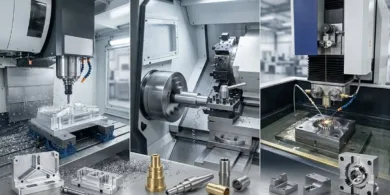
CNC milling
CNC milling is a subtractive process that uses rotating cutters to remove material from a fixed workpiece.
CNC milling is suitable here because it produces accurate pockets, flat faces, and clean edges that allow assemblies to function.
The main working principle is toolpath control, in which a cutter follows a programmed motion to create features at controlled depth and position.
Milling fits parts that are “block-like” or defined by planar geometry.
Slots, pockets, bosses, and mounting faces are feature types that milling can reliably produce.
If your printed part always needs drilling or hand-fitting, milling can remove that uncertainty.
CNC turning
CNC turning is a subtractive process that spins material while a cutter shapes it into round parts.
CNC turning is applicable here because concentricity and diameter control are critical for spacers, shafts, and bushings.
The main working principle is rotational symmetry, enabling cylindrical geometry to be produced quickly and consistently.
Many maker assemblies fail because a round part is not truly round.
A printed cylinder can become slightly oval, causing wobble.
A turned shaft is a part that supports smooth motion because the diameter and finish are controlled.
What materials push you toward CNC (and why)?
Materials push you toward CNC when performance depends on stiffness, heat resistance, or wear behavior.
Aluminum is a metal that maintains its shape under load and during temperature changes better than most printed plastics.
Stainless steel is a metal that improves corrosion resistance and durability in harsh environments.
Delrin is a material that machines into low-friction parts without layered weakness.
If your part touches heat sources, carries load across thin sections, or needs a reliable fit, the material choice often points directly to CNC.
When is sheet metal the better move than printing?
Sheet metal is the better move when your part is a bracket, panel, enclosure, or frame that should be stiff, lightweight, and clean-looking.
Sheet metal fabrication is an approach that cuts and forms flat stock into functional geometry.
A single cut blank plus a few bends can replace a bulky printed structure and still feel stronger in the hand.
This is where flatness stops being a “nice to have.”
A flat panel is a shape that printed plastics struggle to keep straight at larger sizes.
A bent flange is a structural element that adds stiffness without adding weight.
For makers moving from printed brackets to bent metal parts, press brakes are the machines that turn flat laser-cut blanks into rigid, repeatable geometry.
Modern CNC press brakes allow accurate bending across a wide range of thicknesses and materials, making them essential for functional enclosures and frames.
Below are 7 sheet-metal-friendly shapes you see constantly:
- Mounting brackets with flanges
- Enclosure panels and covers
- Chassis plates for electronics
- Guards and shields
- Frames and base plates
- Control panels with cutouts
- Modular plates for quick replacement
Laser cutting
Laser cutting is a process that uses a focused beam to cut sheet material with high precision and repeatability.
Laser cutting is usable here because it produces clean profiles, accurate holes, and fast turnarounds for brackets and panels.
The main working principle is energy concentration, where the beam melts or vaporizes material along a programmed path.
If your part is mostly an outline with holes, laser cutting is often the quickest way to jump to metal.
Profiles, slots, vents, and mounting patterns are features that laser cutting produces well.
It also reduces the “print and pray” cycle for large flat parts.
Punching and forming
Punching and forming is a set of processes that cut holes and create features using tooling rather than a cutting beam.
Punching is suitable here because repeated features can be produced quickly and cost-effectively in large quantities.
The main working principle is tool-driven shaping, where a punch and die create geometry through force.
Louvers and embosses are features that add airflow and stiffness without increasing thickness.
Hardware-friendly forms support faster assembly and consistent alignment.
For designs with repeated hole patterns or formed details, punching can outperform cutting alone.
3D printing vs CNC vs sheet metal: which one should you choose?
3D printing wins for fast iteration and complex shapes, CNC wins for precision and material performance, and sheet metal wins for stiff structures and clean panels.
That comparison becomes clear when you focus on what breaks build: fit, strength, time, and finish.
A prototype is a part that exists to teach you what to change, and printing is excellent at that job.
CNC becomes the answer when “almost fits” becomes a permanent tax on your time.
Sheet metal becomes the answer when your part is fundamentally panel-like or enclosure-like.
For machine builds and automation, motion accuracy also matters.
A servo drive is a device that controls motor torque and speed to achieve precise movement.
Servo controllers are control component that helps motion systems follow commands accurately under load.
For readers working with automation or motion systems, this is a good option to consider.
| Method | Best for | Tolerance reality | Fastest at | Hidden costs | Common mistake |
| 3D Printing | Iteration and complex shapes | Variable | Fit checks | Failed long prints | Ignoring interfaces |
| CNC Machining | Precision and strong materials | Tight | Functional parts | Setup premiums | Over-specifying tolerances |
| Sheet Metal | Panels and enclosures | Good for bends | Stiff structures | Bend complexity | Ignoring the bend rules |
Conclusion
3D printing is powerful, but it is not the right answer for every functional part.
CNC machining wins when precision, repeatability, and material performance drive success.
Sheet metal wins when panels, brackets, and enclosures must stay straight and durable.
Switching processes is not a failure.
It is a sign that your project has matured.
Define the job, identify the non-negotiables, then choose the process that makes the part work without constant fixing.
Liked it?
|
|